EMAT Thickness Gauge: Principle, Advantages and Industrial Applications
Apr 12, 2026
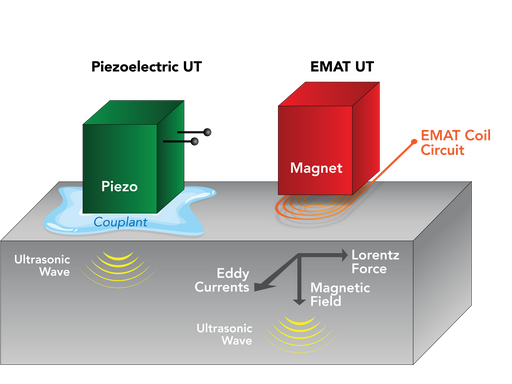
An EMAT thickness gauge (Electromagnetic Acoustic Transducer) is an advanced non-destructive testing (NDT) instrument that measures material thickness without physical contact or couplants. Unlike traditional ultrasonic gauges that use piezoelectric crystals and require coupling gel, EMAT generates ultrasonic waves directly within conductive materials via electromagnetic induction.
How It Works
The core principle relies on Lorentz force (and magnetostriction for ferromagnetic materials):
- A permanent magnet in the probe creates a static magnetic field on the metal surface.
- A high-frequency AC current passes through a coil, inducing eddy currents in the conductive material.
- The interaction between eddy currents and the static magnetic field produces mechanical vibrations (ultrasonic waves) in the material.
- These waves travel through the material, reflect off the back wall, and are detected by the same or another coil.
- The instrument calculates thickness using the time-of-flight of the ultrasonic wave and the known sound velocity of the material.
-
Key Advantages
- Non-contact & couplant-free: Measures through coatings, rust, paint, or air gaps (up to several mm).
- High-temperature capability: Works on hot surfaces up to 650°C (1200°F) without damage.
- No surface preparation: Measures on rough, dirty, or corroded surfaces.
- Wide material compatibility: Steel, stainless steel, aluminum, copper, and other conductive metals.
- Safe and clean: No chemicals, no waste, easy to use in harsh environments.
Typical Industrial Applications
- Power generation: Boiler tubes, steam pipes, nuclear reactor components
- Oil & gas: Pipelines, pressure vessels, storage tanks (corrosion monitoring)
- Manufacturing: Steel plates, forgings, automotive parts, ship hulls
- Infrastructure: Bridges, railway tracks, structural steel beams
- High-temperature processing: Hot-rolled metals, continuous casting lines
-
Conclusion
EMAT thickness gauges represent a breakthrough in non-destructive testing, solving critical limitations of traditional ultrasonic methods. Their ability to perform non-contact, high-temperature, through-coating measurements makes them indispensable for modern industry—improving safety, efficiency, and accuracy in maintenance and quality control.

 English
 العربية
 русский
 español
 português
 Türkçe
 français
 日本語
日本語 Deutsch
 繁體
繁體



 IPv6 網絡支持